The Most Important AI Feature You're Not Using
Value is driven through tribal knowledge, and it is often impossible to pass along to others. You are working with a new technology that demands great inputs to drive results. But the knowledge it needs lives in your head, scattered across documents, past conversations, and muscle memory built over years.
You experiment with AI tools, explore use cases, and open new chats. Each one starts from zero. You are experimenting across standalone interactions instead of building something progressive. Efficiency is lost. Momentum stalls. Eventually, you close the tab and tell yourself AI just doesn't work the way you expected.
Searching Without A Strategy
Most professionals use AI the same way they use a search engine. They have a question, they open a chat, they get an answer, they move on. It works well enough that they keep doing it. But there is a meaningful difference between answering a question and solving a problem. Questions are transactional. Problems are progressive. They build on each other, require context, and compound over time. When you treat every chat as a standalone interaction instead of a chapter in a larger story, you are resetting that progress every single time.
A recent Gallup poll from Q4 2025 found that nearly half of U.S. workers never use AI in their role at all. Of those who do, only 27% of white-collar workers use it at least a few times a week. The tools are available. The gap is not access. It is approach.
I ran into this same wall. Not because the tools were failing me, but because I didn't know what I was missing. It turns out the solution was already built. Most people just never find it.
The Workspace You're Not Using
Creating newsletter content requires time, energy, and most importantly, context. I'm continuously looking for ways to evolve my voice and deliver information that will help people on their AI journey. I'm consistently providing feedback to my AI that leads to better prompts, sharper writing, and focused content roadmaps. But my work lives in a centralized hub, regardless of the model used to execute a task.
Every major AI platform has a version of this: a dedicated workspace where your files, instructions, and chat history live together under one roof. Instead of starting every conversation from scratch, the model already knows your context, your preferences, and your goals. Think of it as the difference between briefing a new consultant every single week versus working with someone who has been embedded in your business for months. The knowledge compounds. The outputs improve. The time you spend re-explaining drops to zero.
Every AI model calls it something different, but the core idea is the same: context, productivity, and strategy in one place.
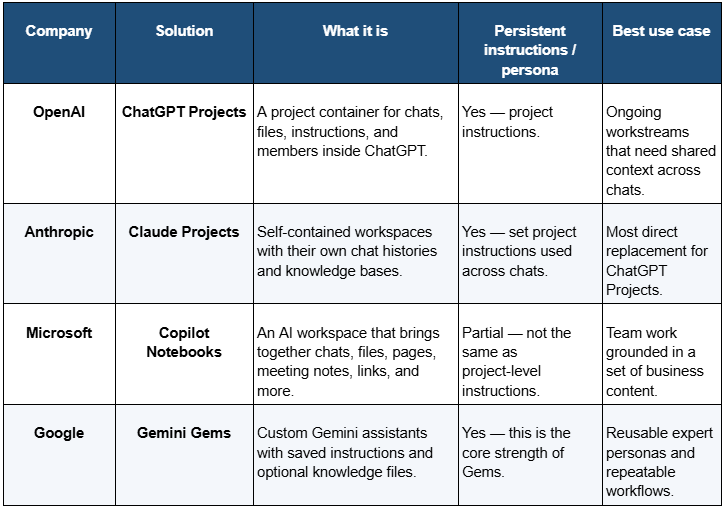
I've been using project features since day one, and it changed how I think about AI entirely.
What I Learned the Hard Way So You Don't Have To
There is only so much time in a day, which is why I try to use AI as a strategic partner and not just a search engine. Implementing my workflows into Projects across multiple platforms taught me valuable lessons that serve as a foundation for every AI interaction I curate.
Tip 1: Transfer your Knowledge
The single biggest benefit of Projects mode is to ground all knowledge in one place. This means linking documents that will help teach the AI, adding standard operating procedures that show how the work is completed, and building instructions that create structure to every chat initiated within the Project. If a standard LLM chat is trained on the entirety of the internet, then think about your Project as training that same LLM only on the context you provide. You are creating a narrow and focused AI assistant that can work alongside you to solve specific problems that only exist in your created universe.
Tip 2: Take Advantage of Memory
AI doesn't just need to be smart, it needs to remember what matters. VentureBeat published in January 2026 that contextual memory will become "table stakes" for enterprise AI deployments this year. This means the AI remembers the decision you made in Tuesday's chat when you open a new one on Friday. I experienced this firsthand when an AI I was working with flagged that the context window was approaching its limit and generated a handover document unprompted, capturing everything needed to pick up exactly where we left off in a new chat. That moment reframed how I think about AI entirely. Think of a Project as giving your AI the full context from your previous conversations, stored and accessible across every chat in the project. You no longer have to repeat instructions or reexplain strategy in a new chat session. I run six content chats every week, each building a different section of my newsletter, all grounded in the same tone, voice, and strategy. That type of symmetry is hard to replicate and a powerful shift in how to think about using AI.
Tip 3: Continuously Improve Your Workflows
This manifested in several ways during my journey with Projects. First, I'm constantly updating prompts and having AI save the changes to memory. This allows me to use real time feedback and adjust prompts with the goal of improving the next output. I also outsource 99% of the project management work directly to AI. This would not be possible without the AI committing context to memory. I have full project plans created with simple prompts, living documents that stay with me regardless of what model I use to execute a task, and placeholders for ideas that are not fully baked yet. I'm able to spend less time tracking and more time executing.
Now What?
Most professionals will read this and nod. A smaller group will open their AI platform, find the Projects feature, and actually build something. That gap is not about access or intelligence. It is about approach.
The professionals who compound their AI skills fastest are not the ones using the newest models. They are the ones who treat every interaction as part of a larger system. They transfer their knowledge, build on it session after session, and continuously refine how they work. The tool gets smarter because they get more intentional.
You already have access to everything described in this post. The workspace exists. The memory features are live. The only thing missing is a problem worth solving and the decision to start. Pick one. Build a Project around it. Give your AI the context it needs to actually help you. Then come back next week and tell me what happened.