The AI Future I Want for My Son
Using AI has changed what I consider possible in my own work. It has also made me increasingly curious about what people with very different expertise are doing with it. Recently, that curiosity led me to Anthropic’s biology research. I started reading about the work and found myself thinking about what these tools could make possible for scientists who have spent their careers investigating disease. The potential to help those people pursue difficult questions, and eventually reduce suffering, gave me another reason to be hopeful about where this technology could lead. I hear plenty about the risks of AI in the news and podcasts I spend time with. I want the work that inspires that hope to be just as much a part of the conversation.
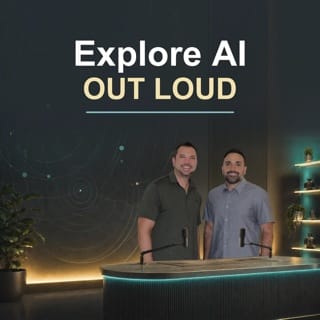 | The podcast Explore AI Out Loud Find practical ways to use AI in your work and everyday life. Learn from real experiments, including the mistakes, so you can spend less time guessing and more time trying something useful. New episodes every other Tuesday. |
 Subscribe on YouTube
 Follow on Spotify
 Follow on Apple Podcasts
What Is Actually Happening in the Lab
Anthropic reported that roughly 950 AI agents searched DNA data over 21 hours. The search used 210 million tokens, the small units of text that language models process. The agents examined candidates and prepared findings for human review, flagging an unusual biological system involving an enzyme and repeating DNA sequences. Scientists then investigated it in the lab. That scale of investigation is what stopped me. I started thinking about what scientists might pursue with that much computational support behind their questions, and how many more possibilities they might be able to explore. The finding remains early, with its biological function still unresolved. Even so, the research gave me a concrete example of the capacity these tools could put in the hands of people working on problems that matter to all of us.
As I read further, Carl Zimmer’s reporting raised questions about how independently Claude had arrived at the finding. A scientist who said he had been studying the same biological system had also used Claude in his research, prompting concerns about whether his unpublished work could have informed the result. Anthropic denied training the model on user transcripts, and the reporting left that dispute unresolved. That matters when judging what this particular experiment demonstrates, even as I remain excited about the broader possibilities. I want to know how much AI contributed, how scientists evaluated its work, and what others can learn from the process. Those details will help us distinguish useful progress from an impressive announcement and give us better reasons to trust the research that follows.
Another recent announcement gave me a different way to think about that progress. The AlphaFold Database has added openly available predictions of viral protein complexes, models of how groups of proteins in viruses may fit together. Scientists can use those structures to investigate potential targets for vaccines and treatments, with laboratory experiments still needed to establish how the biology actually works. What interests me is that the contribution becomes available for other researchers to explore, bringing their own expertise and questions to the same material. If resources like this help more scientists pursue promising ideas, their value could eventually extend far beyond the teams that created them. That is part of the broader benefit I hope AI can help make possible, even while the path from a research resource to better care remains unfinished.
Why This Research Feels Personal
The possibility of better care is what makes this research personal for me. I work in specialty pharmacy, where we serve people living with complex and chronic conditions that require high-cost medications. Much of their care involves managing symptoms and pain or slowing the deterioration caused by disease. That work matters, and it has been my universe for over 13 years. New ways of investigating biology make me wonder how much more we might eventually be able to offer the people we serve, including answers that go beyond helping someone manage a condition.
With my first child on the way, I am also thinking about the world my son will grow up in. I hope to see advances in my lifetime that reduce the suffering caused by cancer, multiple sclerosis, and genetic disorders. For him, I want a future with better answers to diseases that families struggle with today. I cannot know which discoveries will help create that future, but becoming a father gives me another reason to care about the work that could move us toward it.
What excites me is the prospect of giving scientists more capacity to pursue those difficult questions. Their expertise would still guide which ideas are worth investigating, how to test them, and what the results actually mean. If AI can help them work through more information and explore possibilities they might otherwise struggle to reach, that could change the scale of what research teams attempt. The examples I have been reading offer a glimpse of how that collaboration could work. We are still learning where these tools are useful, and I believe their contribution to our understanding of biology is only beginning.
The Risks Are Real. So Are the Opportunities.
These are the kinds of possibilities I want lab leaders, engineers, and politicians to help people understand. When a company announces a more capable model, I would like to hear what that capability is helping someone accomplish and why the result might matter beyond the people building it. Research into disease gives that conversation a human consequence that a benchmark score cannot explain on its own. Showing the work, including its limits and the questions still unanswered, could give people a more useful basis for forming an opinion about AI and its place in their lives.
That also means taking concerns about the buildout seriously. Someone can be excited about scientific progress and still question what happens to entry-level jobs, how data centers affect communities, or whether safety practices are keeping pace. I would welcome that response because it shows someone weighing the implications rather than accepting a position wholesale. A promising application does not justify every decision made in the name of AI. I want a public conversation that helps us examine specific choices, consider who benefits and who bears the costs, and remain open to changing our minds as the evidence develops.
The same scrutiny should extend to the benefits being promised. If better health is part of the case for investing in AI, I want to know how a useful discovery could become care that people can actually receive and afford. Scientific progress alone does not settle those questions, and I cannot assume that its rewards will reach everyone who needs them. My optimism gives me a reason to stay interested in what happens after the announcement. The outcome I care about is whether this work eventually helps people live better lives, and that is what I hope we keep asking the technology and the organizations behind it to deliver.
Finding an Opportunity of Your Own
I already have a much smaller example of that value in my own life. I honestly do not know whether I could devote the time needed to build a quality podcast like Explore AI Out Loud without AI assistance, especially at this point in my personal life. The show still requires ideas, judgment, and work from the people creating it, but having help makes the commitment more feasible.
For you, the opportunity might be a recurring task that consumes time you would rather spend with family, a project at work that has been difficult to move forward, or an idea you have never had the resources to try. You do not have to share my level of optimism to see whether AI could help. Working through a problem you understand gives you something concrete to judge, including where the tool falls short and whether the result justifies the effort. That experience can inform your opinion alongside what you read and hear, while leaving room to remain skeptical and change your mind.
I came to these research stories through curiosity that began in my own work, and they pushed me to think about a future far beyond it. I cannot evaluate every scientific finding myself, but I can keep learning from the people doing the research and pay attention to what holds up under scrutiny. That is how I want to approach a technology that could help shape the world my son inherits. The possibility of a better future is worth taking seriously.
| The podcast Follow Explore AI Out Loud Short clips from each episode, plus what did not make the cut. New episodes every other Tuesday. |
 Follow on Instagram
 Follow on TikTok