The Spam Trap: Fixing Newsletter Deliverability with AI Governance
Building Neural Gains Weekly forces me to learn in public. This is my first journey building out a website and publication from scratch, which has led to many lessons learned along the way. Using AI as a strategic partner helps me identify gaps and quickly build and implement a solution to solve a problem. And, as the models improve and become more powerful, I can harness that intelligence to close blind spots and flaws in my workflows that either I or previous models missed. This week, I want to share an example of this process, where I worked with Gemini 3 Pro to fix an issue that was quietly hurting engagement and growth.
The Problem
My website platform’s (Ghost) default signup flow relies on a double opt-in email. Secure? Yes. Easy? No. As a busy professional, I often trade infrastructure perfection for content creation. But when I looked at subscriber-level data, the reality was stark. High-intent potential subscribers were not completing the signup process and/or never opening the weekly newsletter. I created a test email account to better understand the pain points and found three glaring problems with the signup workflow:
- Invisible Instructions: Users didn't know a confirmation email was on its way.
- The Spam Trap: Confirmation emails were landing in Spam/Promotions and going unseen.
- The Dead End: Confirmed subscribers were missing the weekly newsletter because they never 'whitelisted' the domain and the newsletter landed in Spam/Promotions.
I was losing people before I ever had a chance to engage with them, with zero visibility into lost subscribers. This was an opportunity to leverage AI to help update my code base and deploy a permanent fix without jeopardizing the overall integrity of the site. One wrong line of code and the whole signup form breaks. Blindly pasting AI-generated code is a great way to destroy your production environment. Instead, I used a governance-first workflow to ensure we moved slowly and correctly.
Phase 1: The Code Audit
I did not start by asking for a solution. I started by feeding Gemini my existing code. I uploaded my cover.hbs file and asked it to explain how the current process worked within the existing code base. We needed to establish the "ground truth" of my specific theme before starting to make changes. This ensured that any solution we built would respect the existing architecture rather than fighting against it.
Phase 2: Strategy & Research
I treated Gemini as a consultant, not just a coder. I needed a solution that fixed the workflow without rewriting my entire theme. I started this process by clarifying a stringent set of rules to operate within: Always ask clarifying questions one at a time. Do not hallucinate; if you do not know the answer, say so. Be thorough and always fact check. Do not just agree with me. Push back to ensure the best output.
This framework allows for a consistent approach to solving a problem and clear guidelines for the partnership. Through a back-and-forth ideation, Gemini suggested the best path forward would be to create a redirect page that required minimal changes to the code base. Ghost’s limitations to change the subscription process were a major factor that drove us to this decision. A fact discovered through the research phase and only achievable through a governance-driven workflow. We didn't guess, we verified. This research phase prevented the technical debt that usually comes from hasty quick fixes.
Phase 3: The Fix
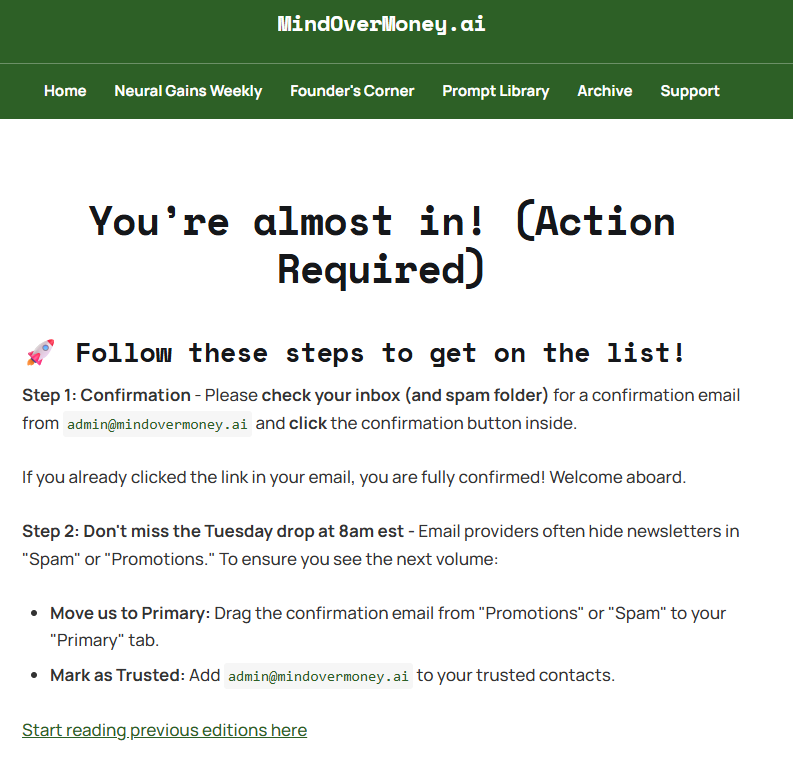
We built a redundant system to ensure every user sees the instructions they need. First, we added a frontend script that watches for a successful signup. The moment a user hits "Subscribe", the site automatically redirects them to a dedicated “Welcome" page with instructions to check their inbox. Second, we changed the Ghost settings to redirect users again after they click the confirmation link in their inbox. This redundancy ensures that even if they miss the first step, they land on the instructions page a second time.
Phase 4: The Infrastructure Check
Finally, we audited the plumbing. We found a mismatch between my subdomain and root domain that was flagging my emails as 'unverified' to Google. By fixing the SPF and DMARC records, we proved to email providers that I am who I say I am. This was the invisible barrier that no amount of good content could overcome.
The Result
This solves the visibility problem completely. Previously, a user would sign up and stay on the homepage, likely missing the confirmation message in their spam folder. Now, the workflow is impossible to miss. A user signs up, is immediately moved to a page that says "Check your spam folder," finds the newsletter to whitelist it, and is reminded again to add us to their contacts upon confirmation.
The Lesson
AI can be a powerful tool to help you solve complex problems in a way that wasn’t possible three years ago. It can act as a senior engineer to generate thousands of lines of code. It can research thousands of documents within a matter of minutes. It can bring solutions to the table when the answer feels impossible. But with any powerful system, it requires guidance and structure. You cannot just "prompt and pray." You have to govern the output, challenge the assumptions, and verify the work. That is how you build leverage without breaking the system.