Volume 9: Feast on the Fundamentals
Hey everyone! 👋
Thanksgiving week feels like the right time to say this out loud: I’m genuinely grateful you carve out a few minutes each week to learn AI with me. It’s easy to get swept up in the AI hype cycle, but slowing down to build real understanding and better money habits is what actually compounds over time.
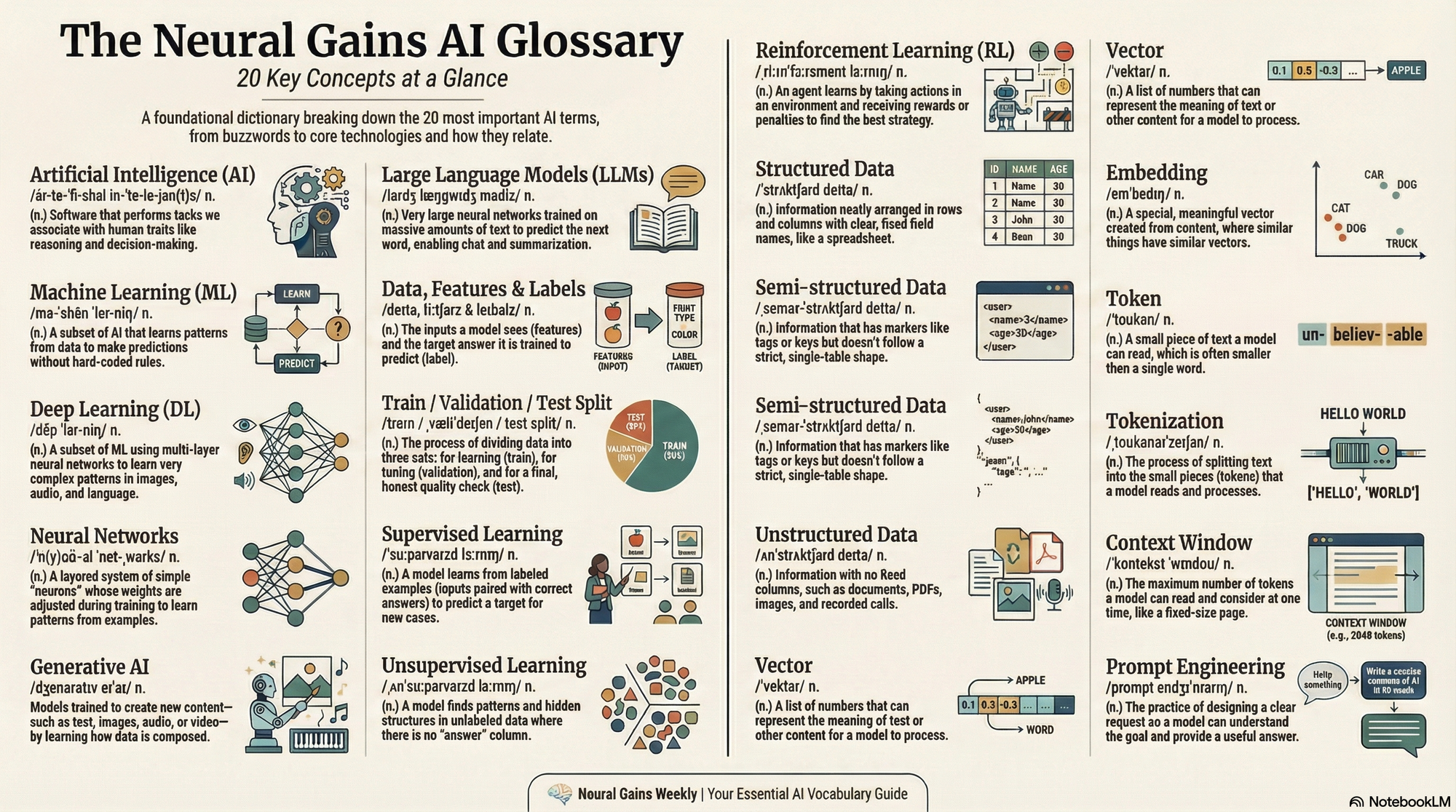
In AI Education, I’ve turned the first eight weeks into a simple recap video and an “AI dictionary” of 20 core concepts we’ve covered so far. This week’s 10-Minute Win is your Black Friday Cart Copilot, built to protect your December cash flow without killing the fun. And in Founder’s Corner, I share a behind-the-scenes story about leaning on AI to fix a problem on MindOverMoney.ai and what it taught me about staying in the driver’s seat. Enjoy and Happy Thanksgiving!
Missed a previous newsletter? No worries, you can find them on the Archive page. Don’t forget to check out the Prompt Library, where I give you templates to use in your AI journey.
Signals Over Noise
We scan the noise so you don’t have to — top 5 stories to keep you sharp
1) A new era of intelligence with Gemini 3
Summary: Google released Gemini 3, its most capable model yet, with big jumps in reasoning, multimodal understanding, and coding, plus a Deep Think mode for harder problems and tight integration across the Gemini app, Search, AI Studio, and Workspace.
Why it matters: This is Google’s real frontier move—better default tools inside Search and Gemini mean more everyday planning, research, and analysis quietly shifting into AI.
2) Trump considering executive order to preempt state AI laws
Summary: A draft executive order would direct DOJ and Commerce to challenge or undermine state-level AI rules (like California and Colorado’s laws) and potentially tie federal broadband funds to states’ AI regulation choices.
Why it matters: Centralizing AI oversight in DC could make life easier for big AI vendors—but at the cost of weaker local protections on deepfakes, bias, and fraud. Builders and investors need to watch how the regulatory map might flatten.
3) EU to ease AI, privacy rules as critics warn of caving to Big Tech, Trump
Summary: The European Commission’s “Digital Omnibus” proposal would let companies train AI on personal data under “legitimate interest” (no consent), and delay key high-risk AI rules by about a year—moves industry loves and rights groups call the biggest rollback of EU digital protections yet.
Why it matters: This is a direct swing at two core constraints on AI: training data and compliance timelines. Looser rules could speed European AI deployment—but raise real privacy and trust questions.
4) Pope: Safeguard human dignity as health systems integrate AI
Summary: Pope Leo XIV told Latin American health leaders that AI in healthcare must serve human dignity, emphasizing that tech can’t replace real relationships between patients and caregivers and must be guided by a clear ethical vision
Why it matters: This is a high-profile, values-focused take on AI in one of the most sensitive domains. For anyone building or investing in health AI, “does this actually respect people, not just optimize throughput?” isn’t a soft question—it’s a reputational and regulatory one.
5) Elon Musk says AI will make work optional and money irrelevant
Summary: In new comments, Elon Musk predicts that within 10–20 years AI and robotics will make work optional and render money “kind of irrelevant,” painting a future where universal high living standards are driven by automated production
Why it matters: It’s a clean example of maximalist AI futurism your readers will see everywhere. Useful not because it’s guaranteed, but because it frames the extremes—then you can sanity-check your own career and money plans against more grounded timelines.
AI Education for You
Recapping your learning journey
It’s Thanksgiving week, which makes it a good time to pause, look back, and say thank you. The past eight weeks have introduced foundational topics in AI, from the basics of intelligence and learning to vectors, embeddings, tokens, and context windows. That is not light reading, especially on top of work, family, and real life.
To make it easier to connect the dots, I put together a short recap video that walks through the “AI Education” journey so far, and a simple dictionary of the 20 big ideas we have covered. Think of this issue as your chance to catch up, lock in the fundamentals, and walk into the rest of the year feeling confident you’ve retained the information. Happy Thanksgiving!
Video will open on the website
Your 10-Minute Win
A step-by-step workflow you can use immediately
🛒 Black Friday Cart Copilot
Why this matters: Between turkey, travel, and “once-a-year deals,” it’s insanely easy to torch your December cash flow in a single weekend. This 10-minute workflow turns your Black Friday/Cyber Monday cart into something smarter: a small, AI-assisted system that helps you rank, sanity-check, and right-size your buys before you click “Place Order.” You’ll walk away with a Buy / Wait / Skip list that still leaves room for fun, but doesn’t wreck your January.
Step 1 — Dump your cart into a simple sheet (2–3 minutes)
Open Google Sheets and create this table:
Add your own items—aim for your top 5–15 most likely purchases.
Keep this sheet open—you’ll copy it into ChatGPT next.
Step 2 — Let AI turn it into a Buy / Wait / Skip matrix (4 minutes)
In a new chat with ChatGPT 5.1, paste your full table (including headers) and use this prompt:
Role: You are my Black Friday Cart Copilot. Your job is to help me spend intentionally without killing all the fun.
Context: I’m looking at my potential Black Friday / Cyber Monday purchases. I want you to help me decide what to Buy, what to Wait 30 days on, and what to Skip entirely.
Data: Here is my cart as a table with columns: Item, Price, Store/Site, Type, Notes.
Instructions:
- For each item, score:
- Need vs Want (Need / Upgrade / Pure Want)
- Joy per Dollar (High / Medium / Low) based on Notes and Type
- Regret Risk (High / Medium / Low)
- Based on those scores, assign one of three decisions:
- Buy – strong case to purchase this weekend
- Wait 30 Days – only buy if I still want it in a month
- Skip – likely impulse or low value
- Output a table with columns:
- Item | Price | Need/Want | Joy per Dollar | Regret Risk | Decision (Buy/Wait/Skip) | One-line Reason
- Then output 3 short bullets:
- “Green lights” total cost (all Buy items sum).
- Amount avoided if I only buy “Buy” and skip the rest.
- One Thanksgiving Spending Rule for me (e.g., “No new gadgets over $200 unless they replace something I sell”).
Rules:
- Be honest but not joyless—some “fun” is allowed.
- If two items are similar, nudge me toward the cheaper one with higher Joy per Dollar.
- Do not assume anything about my income or debt—only use the table + notes.
Scan the output. You should now have a clear Buy / Wait / Skip table plus a custom “Thanksgiving Spending Rule.”
Step 3 — Check your cart against your money picture (2–3 minutes)
Now we sanity-check the “Buy” list.
- Add a new column F (Decision) to your Google Sheet and copy ChatGPT’s decisions (Buy/Wait/Skip) back into the sheet next to each item.
- Add a new cell under the table, e.g., B20, labeled Total_Buy_Spend and enter:
=SUMIF(F2:F16,"Buy",B2:B16)
That gives you a single number: what your AI-approved “green lights” cost.
📊 If you completed Volume 2 (Net Worth Tracker):
- Open your Net Worth sheet and look at your Cash / Savings line.
- Add a quick note: Black Friday "Buy" Total: $XXX (from the formula above).
- If that number is more than 10–15% of your liquid savings, consider moving one or two items from Buy → Wait. This keeps the fun but stops one weekend from nuking your cushion.
Step 4 — Lock in your Thanksgiving rules (1–2 minutes)
Back in ChatGPT, ask it to turn this into a simple rule card you can reuse all weekend:
Take the Buy/Wait/Skip results you just gave me and write a short “Thanksgiving Spending Rules” card with:
- 3 rules that are specific to my patterns (e.g., limit on gadgets, limit on random TikTok buys, cap on total spend).
- 1 sentence I can read before I click “Place Order” that reminds me what future-me actually cares about.
- Keep it friendly, short, and written like you’re talking to me on Thanksgiving evening.
Paste those rules at the top of your Google Sheet or into a Notes app on your phone. That’s your Black Friday Copilot Card—it travels with you across apps and tabs.
The Payoff
Instead of waking up on Monday wondering what just happened to your bank account, you’ll have:
- A one-page cart view with everything in one place
- A clear Buy / Wait 30 Days / Skip decision for each item
- A total “green light” spend number you’re consciously choosing
- A tiny set of Thanksgiving Spending Rules tuned to your actual habits
You still get the dopamine from a few good deals. You just lose the hangover.
Transparency & Notes for Readers
- All tools are free: Google Sheets, ChatGPT Free, your existing browser/app carts.
- Privacy: Don’t paste card numbers, addresses, or login details into AI—only item names, prices, and notes.
- Limits: This doesn’t know your full financial picture; if you’re carrying high-interest debt or have no emergency fund, lean harder into Wait/Skip.
- Educational workflow — not financial advice.
Founder's Corner
Real world learnings as I build, succeed, and fail
Two things can be true at the same time. AI can transform how you work, while also requiring the proper governance to ensure accurate outputs. As I highlighted in Volume 2, I’m constantly working with AI tools to close knowledge gaps and build code to customize the experience on MindOverMoney.ai. This process keeps getting more efficient as the intelligence of large language models expands. But that doesn’t mean you can let AI write code, solve problems, generate answers, and help you work without governance in place. I want to walk you through my latest challenge and how AI saved the day, but only with my oversight.
The Problem:
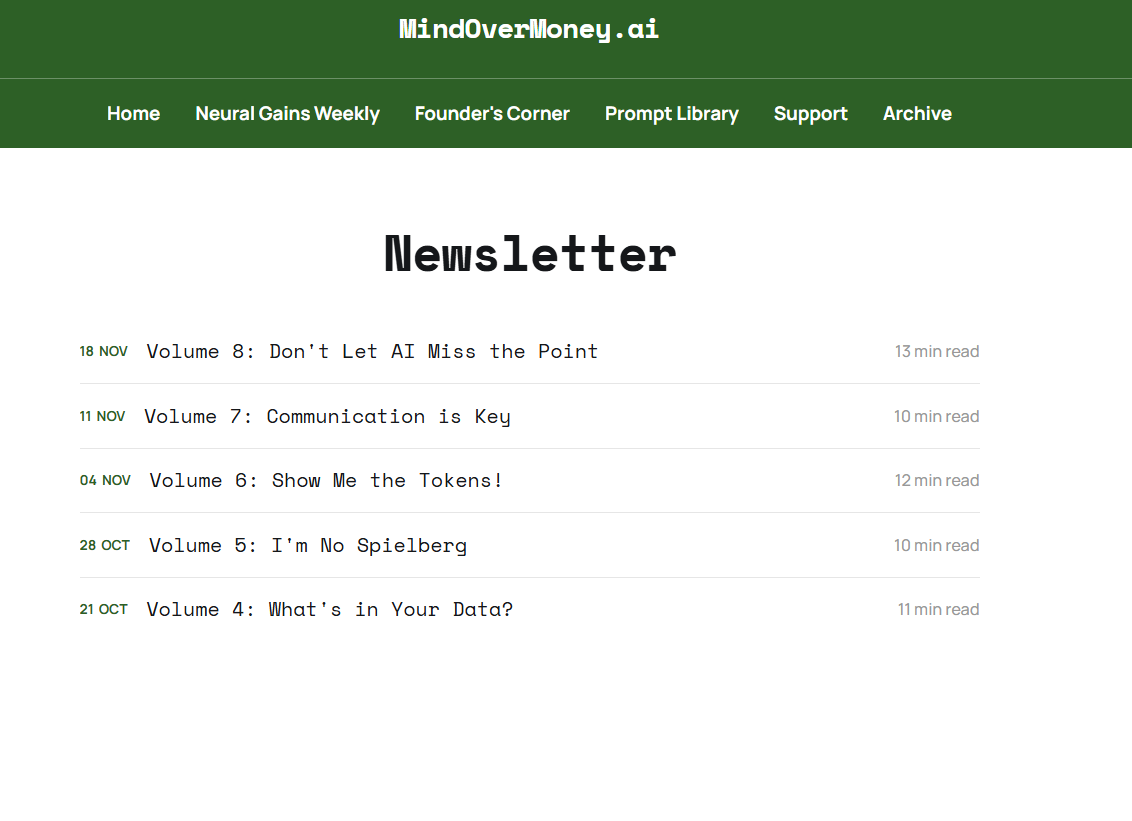
I recently ran into a critical bug on the website. The "Infinite Scroll" feature, which automatically loads older posts as you scroll down, was completely broken on the Archive, Founder’s Corner, and Prompt Library pages (visual below). If you scrolled to the bottom, nothing happened. The older content was stranded, inaccessible to anyone visiting the site. Not a great look as new subscribers who wanted to start at the beginning tried to access these links. As I’ve mentioned before, I am not a coder. I rely on my AI partner (Gemini, in this case) to act as my lead developer. So, I did what I always do: I explained the problem, pasted my code, and asked for a fix.
The Process:
Gemini 2.5 Pro with Thinking is a great model, and it went to work analyzing my current code in GitHub to look for a solution. I find it fascinating to read the model’s ‘thinking’ process as it scours thousands of lines of code in a matter of seconds. AI’s ability to read and write code seems like magic and highlights the power of this technology. Gemini confidently identified the issue and generated a fix for me to deploy. I did my part, but the issue remained unsolved. This pattern continued on for about one hour, leading to approximately 15 code changes. The last change fixed the “infinite scrolling” issue, but broke three other elements of my site. AI is powerful, but the human element was needed to get this project back on track.
I stopped the deployment efforts and reset the discovery process in the chat. It was time to debug the AI itself. I went through each element of the website that was broken and gave direct instructions to my AI coding assistant. Specifically, I had the AI navigate to the website and experience the breaks as if they were a new visitor. I shared the live source code to compare it to the GitHub code. I instructed the AI to research online forums and YouTube to find the correct solution before writing the final code change. After 30 minutes of research and dialogue, we finally found the exact root cause. Gemini was writing perfect code for a source file (main.js), but my live website was running on a compiled version (main.min.js) that wasn't being updated by my deployment process. The AI was solving the right problem in the wrong room. It took collaboration and strict oversight from me to deploy a solution that fully fixed the original issue without breaking other aspects of the site.
The Lesson:
This experience reinforced a massive lesson that applies to anyone using AI: You cannot abdicate responsibility.
We often treat these models like magic boxes that have all the answers. We assume that because they can write code or summarize text, they understand the full context of our business or environment. They don't. In fact, research backs up exactly what I experienced. A recent study presented at the Computer-Human Interaction Conference found that 52% of ChatGPT’s programming answers contain misinformation. Even more telling, users preferred those incorrect answers 35% of the time simply because they were polite and comprehensive. That is exactly the trap I fell into: the AI was confident, so I didn’t probe to ensure the right fix was being deployed.
I treated Gemini like a senior engineer who knows everything, and that broke my homepage in the process. But when I started treating it like a junior developer, talented but inexperienced and needing its work checked, I found the right solution. This aligns with what experts are seeing across the industry. The 2025 Stack Overflow Developer Survey reported that the biggest frustration for 66% of developers is dealing with AI solutions that are "almost right, but not quite." That "almost right" code is dangerous because it creates what experts are now calling "AI Debt", the hidden cost of cleaning up hasty AI code later.
Governance isn't just a corporate buzzword. For us "AI Doers," governance is the discipline of pausing and asking, "Does this actually make sense?" before we hit enter. You have to audit the output. You have to verify the logic. You have to be the one to say "Stop" when the solution looks risky. AI can write the code and create amazing outputs, but you still have to be the one to steer the ship. At least for now…
Goals & Milestones:
Follow us on social media and share Neural Gains Weekly with your network to help grow our community of ‘AI doers’. You can also contact me directly at admin@mindovermoney.ai or connect with me on LinkedIn.