I Used the Most Powerful AI on Earth for Two Minutes
My phone buzzed at 9:56 on a Friday night. A friend, asking whether I had tried Claude Fable yet. I typed a reply without thinking, and only later did the tense catch my attention.
"They just took it down. But I used it for like 2 minutes."
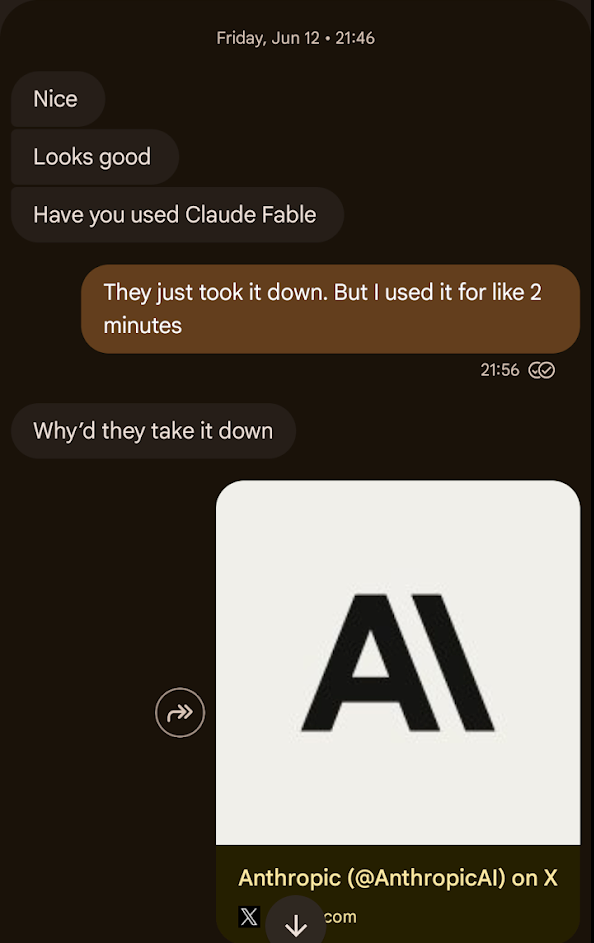
I was already talking about the strongest AI model available to the public as something that had come and gone. The news was breaking faster than we could text about it. The United States government had forced Fable offline the same evening I used it for the first time.
That night, I had opened Fable for ordinary work, the start of a Founder's Corner brief. It never finished. Mid-task, the model vanished, and Opus 4.8 picked up where the most powerful AI on earth had been sitting seconds before. I cannot tell you what Fable felt like to use. Two minutes was not enough to learn anything. Everything I know about it fits in one text message, written in the past tense.
Eighteen Confusing Days, Told Plainly
None of this surprised me, and that is the uncomfortable part. I have spent the past year writing that compute would become the bottleneck for AI and that the consumer squeeze had already started, with relief flowing where the revenue is. What I could not have written is how fast it would accelerate. When the most capable models become scarce, consumers are last to receive them and first to lose them. June 12 turned that sentence from a prediction into a Friday night.
Fable 5 and Mythos 5 are the same model underneath. Same training, same weights. Mythos is the unrestricted version, and it has never been public. Approved institutions have run it since April. Fable is the version Anthropic wrapped in safety layers before handing it to the rest of us. Ask it something risky in cybersecurity, biology, or chemistry and it quietly passes the request to a smaller model, Opus 4.8. Anthropic says at least 95 percent of Fable sessions never trip those layers at all.
On June 9, Fable went public. Three days later the US Commerce Department pulled it with an export-control directive, a national security order that decides who may use a technology. Anthropic had no way to comply halfway, so it shut off both models for everyone on the planet, including its own employees who are not US citizens.
The trigger was a jailbreak, a way of talking a model past its own safety rules. Anthropic disputed it, arguing the finding was narrow and that other public models, including GPT-5.5, could already do the same thing. I will not wave the government's concern away as theater. It was specific, and a government acted on it. The capability was also common across the industry. When Anthropic tested the technique, every model it tried could reproduce it, including far smaller ones, which is why pulling one model changed very little.
Over at OpenAI, the pattern was repeating in the same weeks. Its newest models, GPT-5.6, launched as a limited preview to roughly twenty organizations, and only after OpenAI shared the models and its launch plans with the government. Access gets approved one customer at a time. The strongest AI from both leading labs now arrives gated, and the public is not on the early list.
The safety story explains why the models went dark, and it says nothing about the order in which they came back.
Who Got It Back First
The ban ended the way it began, on the government's schedule. The shutdown had hit everyone in a single motion, but the restoration arrived in stages. Mythos came back first. On June 26, the government cleared the stronger, less restricted model for a set of US organizations that run and defend critical infrastructure, and more than a hundred institutions came back online. The public waited four more days. When the export controls were lifted on June 30 and Fable returned on July 1, consumer plans got it capped at half the normal weekly usage through July 7, then metered behind paid credits. Mythos returned only to the vetted list it had always been limited to. There is no signup page and no waitlist. Getting on that list is a matter Anthropic negotiates with the government, one set of organizations at a time.
Why that sequence? Nobody explained it, and nobody had to, because the explanation was already on file. On June 1, eleven days before the ban, Anthropic filed confidential IPO paperwork at a valuation near 965 billion dollars, and OpenAI followed a week later at roughly 852 billion. A company months from an IPO makes every decision with one eye on durable revenue, and for these labs the durable revenue is no longer the consumer. OpenAI says enterprise already makes up more than forty percent of its revenue and should match consumer by the end of this year. The customers who justify a trillion-dollar valuation got the frontier back four days ahead of the public, and the rest of us got a cap and a meter.
Anthropic told us the consumer terms before the government ever knocked. On launch day, it announced Fable would stay inside the subscription plans only through June 22, then move to usage credits priced at exactly double Opus 4.8, ten dollars per million tokens it reads and fifty per million it writes. The ban arrived three days into that window. It interrupted a metering plan that was already written down, and the return simply restarted the clock.
If this sounds like a conspiracy, it is not one. A government moved on a documented security finding, two companies are racing to the public markets with Goldman Sachs and Morgan Stanley already hired, and the business model pays better serving institutions than individuals. Three different reasons produced the same sequence. Institutions first, consumers at the end of the line.
Access Can Move Backward
Twenty years of consumer technology trained us to expect one direction. Whatever the powerful hold today, everyone else holds cheaper tomorrow. The newest phone becomes next year's midrange. The expensive software adds a free tier. Intelligence, by every precedent we had, would follow the same path down. June broke the precedent. Access rose to the institutions, reversed for everyone at once, and returned to the public last, capped, and on terms set above the user's head.
Buried in the resolution sits the detail I cannot stop thinking about. Anthropic agreed to give government partners early access to evaluate frontier models before the public ever sees them. The order that put consumers last during a crisis is now written into how these models get released going forward.
Most people do not need the absolute frontier on a Tuesday. Opus 4.8 handles the vast majority of real work, and the loss lands first on a small group of advanced users running the hardest tasks. All of that is true.
Small groups do not stay small when the frontier keeps moving. I call it the access gap, the distance between what the most capable intelligence can do and what most people are allowed to use. That distance compounds. Institutions holding the strongest models pull further ahead every month, and everyone a tier below starts each race a step behind.
After more than a decade inside healthcare, I can tell you where the access gap turns into patient outcomes. An advanced academic medical center can run frontier-grade diagnostic AI on its hardest cases while a rural clinic two hundred miles away works with whatever tier it can afford. The talent is the same on both sides. What separates them is the level of intelligence each is allowed to hold, and the patients furthest from the frontier feel it last and feel it worse.
Keeping the most capable intelligence inside a few institutions while it accelerates will reshape who competes, who builds, and who gets cared for well. That is not hyperbole. It is what the access gap does when it compounds for years instead of months. Fable's return softens nothing. What came back is conditional, metered, and revocable, and what was pulled once can be pulled again.
The One Lever You Actually Control
Which models get built, which get sold, and which get switched off by a government on a Friday night are all decisions made without you. The only thing that has ever separated two people using the same tools is what each of them knows how to do with them. That is the lever.
Somewhere out there is a company, maybe a competitor, maybe a future employer, holding intelligence you are not allowed to touch. Competing in that world is a matter of craft, the kind that gets great results from whatever model you can actually reach. That craft is the move From User to Builder, and right now it is plain self-defense. When you understand a workflow deeply enough to direct any model through it, losing the frontier tier costs you less. The thinking was never outsourced in the first place.
Getting there is simple to name and hard to do. Break a real task into steps a model can carry. Learn what a precise instruction looks like, and where models tend to fail, so you can catch the mistakes before they cost you. The last step is practice, on the tools you can keep, until the workflow is yours. Skill narrows the distance that access created, and skill travels with you every time the tools change.
The Two Minutes Are Still the Whole Story
I keep returning to those two minutes, and what pulls me back is how little say I had in when they ended. A year of writing about the consumer squeeze taught me less than a Friday night and a past-tense text.
Keep the part of this you control. The most powerful tools will come and go on someone else's schedule. What you do with the ones you keep is yours completely. That was never theirs to take.