Volume 41: The Best AI You Are Not Allowed to Use
The most powerful AI ever released to the public lasted three days. I used it for about two minutes before the government forced it offline mid-task, and what came back days later was capped and handed to large institutions first. For twenty years the newest technology trickled down to everyone, and that just reversed.
🧭 Founder's Corner: Why the strongest AI now flows to a handful of institutions ahead of everyone else, and the one advantage no government or company can switch off.
🧠 AI Education: A hidden workspace inside your AI assistant, off by default, that turns drafting into real iteration, and the one kind of work it still hands back to you unfinished.
✅ 10-Minute Win: Rehearse the conversation you are dreading out loud against an AI that plays your toughest audience and pushes back, then tells you which answer landed weakest.
Let's jump in.
Enjoying the weekly content? Forward this volume to a colleague, friend, or family member to subscribe.
Signals Over Noise
We scan the noise so you don’t have to — top 5 stories to keep you sharp
1) FDA clears EchoNext, an AI that spots hidden heart disease from a standard ECG
Summary: The FDA cleared EchoNext, from Pathway Labs, the first AI tool that reads a routine 12-lead ECG to flag six kinds of structural heart disease that usually go undetected until a patient has symptoms. Trained on more than 700,000 ECG and echocardiogram pairs, it caught 77 percent of cases in one study, versus 64 percent for cardiologists reading the same ECGs.
Why it matters: This turns a cheap test millions of people already get into an early warning screen for a disease that rarely announces itself. It is a concrete case of AI adding a capability humans do not have, rather than just speeding up work they already do.
2) Health systems say AI governance needs collaboration, not another handoff
Summary: At the HIMSS AI in Healthcare Forum, health system leaders said effective AI governance keeps getting blocked by overlapping regulations, patient opt-out laws, and siloed data, and they offered a practical fix: a standing data governance council that includes clinical, IT, compliance, and legal staff.
Why it matters: Governance is where most AI efforts stall, in healthcare and everywhere else. The takeaway travels well beyond hospitals. Before you scale a tool, decide who owns the data, who reviews the output, and who is accountable when it gets something wrong.
3) OpenAI proposes giving the US government a 5% stake
Summary: OpenAI has proposed handing the US government a roughly 5 percent stake, worth about $42.6 billion, and suggested other leading AI firms cede similar stakes into a public fund. CEO Sam Altman framed it as a way to share AI's gains with the public, though the talks are early and may require Congress.
Why it matters: How AI companies and governments entangle will shape the rules you eventually work under, from data access to which models you are even allowed to use. Watch this less for the dollar figure and more for what public ownership could do to oversight and trust.
4) Anthropic launches Claude Science and its own drug discovery program
Summary: Anthropic launched Claude Science on June 30, an AI workbench that pulls more than 60 research tools and databases into one place, and said it will run its own preclinical drug discovery programs aimed at neglected and rare diseases that traditional drugmakers tend to skip.
Why it matters: This is a bet that the same agent approach that changed how software gets built can change how science gets done. For anyone in a research-heavy or regulated field, it previews AI moving from drafting emails to doing the specialized, multi-step work at the core of the job.
5) California signs a first-of-its-kind deal to put Claude in state agencies
Summary: On June 29, Governor Newsom announced a partnership giving every California state agency, city, and county access to Anthropic's Claude at a 50 percent discount with free workforce training, making it the first AI tool cleared for statewide use. Agencies are already using it at the DMV, the health care services department, and for cybersecurity.
Why it matters: When the largest state government standardizes on one AI assistant and trains its workforce on it, it sets a template other public and private employers will study. The phrase to notice is "assist, not replace," which is the same question every organization is now working through.
Missed a previous newsletter? No worries, you can find them on the Archive page.
Founder's Corner
I Used the Most Powerful AI on Earth for Two Minutes
My phone buzzed at 9:46 on a Friday night. A friend, asking whether I had tried Claude Fable yet. I typed a reply without thinking, and only later did the tense catch my attention.
"They just took it down. But I used it for like 2 minutes."
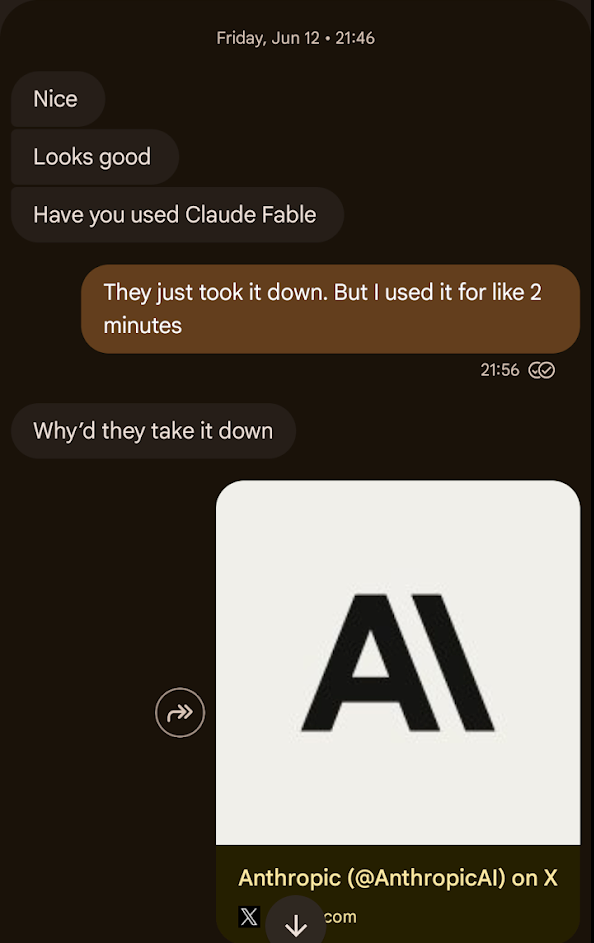
I was already talking about the strongest AI model available to the public as something that had come and gone. The news was breaking faster than we could text about it. The United States government had forced Fable offline the same evening I used it for the first time.
That night, I had opened Fable for ordinary work, the start of a Founder's Corner brief. It never finished. Mid-task, the model vanished, and Opus 4.8 picked up where the most powerful AI on earth had been sitting seconds before. I cannot tell you what Fable felt like to use. Two minutes was not enough to learn anything. Everything I know about it fits in one text message, written in the past tense.
Eighteen Confusing Days, Told Plainly
None of this surprised me, and that is the uncomfortable part. I have spent the past year writing that compute would become the bottleneck for AI and that the consumer squeeze had already started, with relief flowing where the revenue is. What I could not have written is how fast it would accelerate. When the most capable models become scarce, consumers are last to receive them and first to lose them. June 12 turned that sentence from a prediction into a Friday night.
Fable 5 and Mythos 5 are the same model underneath. Same training, same weights. Mythos is the unrestricted version, and it has never been public. Approved institutions have run it since April. Fable is the version Anthropic wrapped in safety layers before handing it to the rest of us. Ask it something risky in cybersecurity, biology, or chemistry and it quietly passes the request to a smaller model, Opus 4.8. Anthropic says at least 95 percent of Fable sessions never trip those layers at all.
On June 9, Fable went public. Three days later the US Commerce Department pulled it with an export-control directive, a national security order that decides who may use a technology. Anthropic had no way to comply halfway, so it shut off both models for everyone on the planet, including its own employees who are not US citizens.
The trigger was a jailbreak, a way of talking a model past its own safety rules. Anthropic disputed it, arguing the finding was narrow and that other public models, including GPT-5.5, could already do the same thing. I will not wave the government's concern away as theater. It was specific, and a government acted on it. The capability was also common across the industry. When Anthropic tested the technique, every model it tried could reproduce it, including far smaller ones, which is why pulling one model changed very little.
Over at OpenAI, the pattern was repeating in the same weeks. Its newest models, GPT-5.6, launched as a limited preview to roughly twenty organizations, and only after OpenAI shared the models and its launch plans with the government. Access gets approved one customer at a time. The strongest AI from both leading labs now arrives gated, and the public is not on the early list.
The safety story explains why the models went dark, and it says nothing about the order in which they came back.
Who Got It Back First
The ban ended the way it began, on the government's schedule. The shutdown had hit everyone in a single motion, but the restoration arrived in stages. Mythos came back first. On June 26, the government cleared the stronger, less restricted model for a set of US organizations that run and defend critical infrastructure, and more than a hundred institutions came back online. The public waited four more days. When the export controls were lifted on June 30 and Fable returned on July 1, consumer plans got it capped at half the normal weekly usage through July 7, then metered behind paid credits. Mythos returned only to the vetted list it had always been limited to. There is no signup page and no waitlist. Getting on that list is a matter Anthropic negotiates with the government, one set of organizations at a time.
Why that sequence? Nobody explained it, and nobody had to, because the explanation was already on file. On June 1, eleven days before the ban, Anthropic filed confidential IPO paperwork at a valuation near 965 billion dollars, and OpenAI followed a week later at roughly 852 billion. A company months from an IPO makes every decision with one eye on durable revenue, and for these labs the durable revenue is no longer the consumer. OpenAI says enterprise already makes up more than forty percent of its revenue and should match consumer by the end of this year. The customers who justify a trillion-dollar valuation got the frontier back four days ahead of the public, and the rest of us got a cap and a meter.
Anthropic told us the consumer terms before the government ever knocked. On launch day, it announced Fable would stay inside the subscription plans only through June 22, then move to usage credits priced at exactly double Opus 4.8, ten dollars per million tokens it reads and fifty per million it writes. The ban arrived three days into that window. It interrupted a metering plan that was already written down, and the return simply restarted the clock.
If this sounds like a conspiracy, it is not one. A government moved on a documented security finding, two companies are racing to the public markets with Goldman Sachs and Morgan Stanley already hired, and the business model pays better serving institutions than individuals. Three different reasons produced the same sequence. Institutions first, consumers at the end of the line.
Access Can Move Backward
Twenty years of consumer technology trained us to expect one direction. Whatever the powerful hold today, everyone else holds cheaper tomorrow. The newest phone becomes next year's midrange. The expensive software adds a free tier. Intelligence, by every precedent we had, would follow the same path down. June broke the precedent. Access rose to the institutions, reversed for everyone at once, and returned to the public last, capped, and on terms set above the user's head.
Buried in the resolution sits the detail I cannot stop thinking about. Anthropic agreed to give government partners early access to evaluate frontier models before the public ever sees them. The order that put consumers last during a crisis is now written into how these models get released going forward.
Most people do not need the absolute frontier on a Tuesday. Opus 4.8 handles the vast majority of real work, and the loss lands first on a small group of advanced users running the hardest tasks. All of that is true.
Small groups do not stay small when the frontier keeps moving. I call it the access gap, the distance between what the most capable intelligence can do and what most people are allowed to use. That distance compounds. Institutions holding the strongest models pull further ahead every month, and everyone a tier below starts each race a step behind.
After more than a decade inside healthcare, I can tell you where the access gap turns into patient outcomes. An advanced academic medical center can run frontier-grade diagnostic AI on its hardest cases while a rural clinic two hundred miles away works with whatever tier it can afford. The talent is the same on both sides. What separates them is the level of intelligence each is allowed to hold, and the patients furthest from the frontier feel it last and feel it worse.
Keeping the most capable intelligence inside a few institutions while it accelerates will reshape who competes, who builds, and who gets cared for well. That is not hyperbole. It is what the access gap does when it compounds for years instead of months. Fable's return softens nothing. What came back is conditional, metered, and revocable, and what was pulled once can be pulled again.
The One Lever You Actually Control
Which models get built, which get sold, and which get switched off by a government on a Friday night are all decisions made without you. The only thing that has ever separated two people using the same tools is what each of them knows how to do with them. That is the lever.
Somewhere out there is a company, maybe a competitor, maybe a future employer, holding intelligence you are not allowed to touch. Competing in that world is a matter of craft, the kind that gets great results from whatever model you can actually reach. That craft is the move From User to Builder, and right now it is plain self-defense. When you understand a workflow deeply enough to direct any model through it, losing the frontier tier costs you less. The thinking was never outsourced in the first place.
Getting there is simple to name and hard to do. Break a real task into steps a model can carry. Learn what a precise instruction looks like, and where models tend to fail, so you can catch the mistakes before they cost you. The last step is practice, on the tools you can keep, until the workflow is yours. Skill narrows the distance that access created, and skill travels with you every time the tools change.
The Two Minutes Are Still the Whole Story
I keep returning to those two minutes, and what pulls me back is how little say I had in when they ended. A year of writing about the consumer squeeze taught me less than a Friday night and a past-tense text.
Keep the part of this you control. The most powerful tools will come and go on someone else's schedule. What you do with the ones you keep is yours completely. That was never theirs to take.
Share Neural Gains Weekly with your network to help grow our community of ‘AI doers’. You can also contact me directly at admin@mindovermoney.ai or connect with me on LinkedIn.
AI Education for You
Artifacts and Long-Form Work: Claude's Professional Edge
The Setup
There is a Claude feature that stays completely invisible until you turn it on, and it happens to be the one that changes long-form work the most. A healthcare operations professional had used Claude for months without ever seeing it, because the setting that controls it sits off by default on the plans most people use.
She found it the week she had three things due by Friday. A one-page process summary for her team. A longer quarterly program report for her director. A short slide deck for a stakeholder meeting. Her usual method was to ask Claude in the chat, copy the answer out, and paste it into a Word file, over and over. A colleague who had watched her do this told her to stop, and pointed her to a setting she had never opened: under Settings, in Capabilities, a toggle labeled Code execution and file creation. She switched it on, and for the first time Claude's workspace appeared. This is what the week taught her about it.
The Document: Where It Clicks Immediately
She began with the process summary because it was the smallest job.
She described what she needed, and instead of burying the result in the scrolling chat, Claude opened a separate window to the right and wrote the summary there. The document had a home. It was not sandwiched between her questions and Claude's explanations; it sat in its own space, the way a file sits in its own window.
Then she found out how editing worked. She did not have to describe the paragraph she wanted changed. She highlighted the sentence directly in the document, clicked Edit with Claude, and typed what she wanted. The change landed exactly where she marked it. When she tried two openings, a version selector let her flip between them without losing the first to write the second. For work that is mostly drafting and redrafting, this is where the shift pays off. The writing stopped being a message she copied out and became a workspace she shaped directly.
The Report: Strong, With Real Iteration
The quarterly report was a bigger job, and it is where she learned what the workspace is actually for.
The report had sections: a summary, program metrics, a few observations, a list of next steps. She built it one part at a time, reading each before asking for the next. Because the whole thing lived in the artifact window instead of scattered across a dozen chat messages, she watched it take shape as a single document. When her director's framing shifted midweek and she needed to recut the observations, she did not start over. She pointed Claude at that section and iterated.
This is the genuine professional edge, and it is narrower and more real than the marketing version. The edge is not a first-draft miracle. It is that complex, multi-step content stays in one place while she works it, so her effort goes into refining the draft instead of reassembling it from scattered replies. Every copy-and-paste revision she used to make was another round trip. Here, the document was the workspace.
She did hit a limit worth naming. The report referenced current enrollment figures, and Claude did not have them until she provided them. The workspace is excellent at structure and language. The tool shapes what she gives it; it does not go find what she withholds. She pasted the figures in, and from there it was smooth, but the lesson stuck.
The Presentation: Where She Meets the Edge
The slide deck is where honest accounting comes in, because this is where the experience changed.
She asked for the presentation, and Claude built it as a file she downloaded, not as the fluid, edit-in-place document she had with the summary. It was a real starting point. The structure was sound, the content was organized, the talking points were there. What it was not was the polished, on-brand deck she could stand up and present as-is. She opened it in her own presentation software and did the visual work herself: the spacing, the emphasis, the final design choices that make a deck feel finished.
A sales pitch would skip this part, so it is worth stating plainly. Artifacts are strongest with documents and structured text, the writing-and-iterating work where the summary and the report lived. Slides come out as a strong first draft that needs her polish. Knowing that in advance changed how she used the tool. She let it handle the thinking and the first structure and budgeted her own time for the finish. The disappointment only shows up for people who expect a press-ready deck in the first place.
What She Learned by Friday
All three were done, and the week beat her old copy-and-paste routine handily. What she took away was a single principle she could carry to any task: Artifacts turns AI output from something you extract into something you work inside, and that shift pays off in exact proportion to how much a task rewards iteration. The document and the report, all draft-and-redraft, are where it earns its keep. The presentation, which needs a designer's final touch, is where it hands back to you. Match the task to that gradient and the tool feels like a partner. Ignore it and you fight the tool.
What to Take From This
- Artifacts are off until you switch it on. On Free, Pro, and Max, look under Settings, then Capabilities, and turn on Code execution and file creation. Until you do, the workspace stays invisible, which is why so many people never know it exists.
- The real edge is iteration, so use it for iterative work. Complex, multi-step content stays in one window while you refine it, and your effort goes into improving the draft instead of rebuilding it from chat fragments.
- For Markdown documents, you can edit in place. Highlight the exact text, click Edit with Claude, and the change lands where you marked it. The version selector lets you try directions without losing earlier work.
- Know where the tool tapers off. It does not pull your live data on its own, so paste in what it needs. Slide decks arrive as strong starting points that you finish in your own software.
- An artifact in a conversation does not save to your sidebar by itself. If you want to keep one, publish it. Otherwise it stays attached to that chat.
How This Connects
This is the third part of the Claude Deep Dive. Vol 39 was first contact and the free plan's genuine core. Vol 40 went under the hood on memory and projects, the features that let context accumulate. This volume put that context to work on real deliverables and showed both the edge and the limit of the Artifacts workspace: outstanding for documents and long-form iteration, a strong starting point for slides, and dependent on the information you actually hand it. Pairing a project from Vol 40 with the Artifacts workspace is where the platform starts to feel like somewhere you get real work done. Next week, Vol 42 closes the series with Claude Code and the agentic future, and makes the case that the agentic shift reaches well beyond developers. The thread through all four parts is one honest, hands-on account of what the tool is actually like to use, limits included.
Part 3 of 4 in the Claude Deep Dive series.
Your 10-Minute Win
A step-by-step workflow you can use immediately
Practice the Talk You're Dreading
You spent three hours on the deck and four minutes on what you were actually going to say. Then the meeting starts, someone asks the one question you were hoping to skip, and you hear yourself stall. You knew the answer. You had just never said it out loud before. The board readout, the tough 1:1, the interview: these are the moments you prepare for least, because rehearsing them feels awkward and the calendar never leaves room.
The fix is not more notes. It is one rehearsal out loud against someone who pushes back, and conversational voice AI can play that someone. You tell ChatGPT voice or Gemini Live who to be, how hard to push, and what you are rehearsing, and it becomes your skeptical CFO or your hiring manager for ten minutes. You get to freeze in private, where it costs nothing, instead of in the room, where it costs the promotion.
Voice AI has shown up in this section before. Back in Vol 21 we used it to turn a rambling memo into a calendar plan. Here it does the reverse and talks back. The AI plays the other side of the table, interrupts you, and asks the questions you are dreading, then drops the act and tells you which answer landed weakest. You keep the judgment on your message. It supplies the reps you would never get otherwise.
The Workflow
1. Frame the room (2 minutes)
Open ChatGPT. In text, paste a brief that tells the AI who to be and how hard to push, then start voice mode in that same conversation so it keeps the context when you begin talking. On Gemini, brief it the same way as you open Gemini Live.
Copy/Paste Prompt: "You are [ROLE, e.g., my company's CFO, and a skeptical one]. I am about to rehearse [THE CONVERSATION IN ONE SENTENCE, e.g., a five-minute ask for budget to hire two engineers]. Play this person realistically. Let me give my opening, then interrupt, ask the hard questions they would actually ask, and push back when my answers are thin. Stay in character until I say break, and do not coach me yet."
2. Rehearse out loud (4 minutes)
Tap voice and deliver your opening as if it were real. Let the AI cut in and challenge you, and answer in the moment. This is the rep you never take: saying the words under live pushback, the way the real moment will demand. Go two or three rounds. The question that makes you stall is exactly the one worth finding now, while it is still free to get wrong.
3. Break character and debrief (3 minutes)
Say "break" and turn the AI from your audience into your coach.
Copy/Paste Prompt: "Break. Step out of character. You just heard me rehearse. Tell me the one answer that was weakest and why, the exact question I stumbled on, and one sharper way to open. Be specific and blunt, and skip the praise padding."
4. Take the notes, keep the call (1 minute)
Read the debrief and decide which notes are right. The AI does not get the last word on your message; you do. Pick your weakest moment, run that one exchange again out loud until it lands, and copy the debrief so you walk in holding it.
The Payoff
You walk in having already heard the hardest question and answered it once. You keep two assets: a short debrief of your weak spots, and a reusable role brief you can aim at the next conversation you dread. The real change is the habit. You stop rehearsing in your head and start rehearsing out loud, under resistance, where it actually counts.
The AI Concept You Just Used
This is AI role-play rehearsal. Most people use AI to write the thing they have to deliver. You used it to become the person on the receiving end, which is a different and underused move. Configuring the AI's role and its pushback level is the real skill here, and it carries to any prep that scares you: a job interview, a salary negotiation, a difficult 1:1, a pitch. Same pattern, new audience.
Transparency & Notes
- ChatGPT gives free users about two hours of voice a day on its lighter model, which easily covers a ten-minute rehearsal. Its most natural Advanced Voice comes as a short daily preview on the free plan. Gemini Live is free with a Google account. No paid plan is required for either.
- Brief the role inside the same chat and rehearse from what you say out loud. Free voice works best this way, rather than leaning on it to read an uploaded document.
- Do not speak confidential names, real numbers, or protected information into the tool. Rehearse the shape of the conversation with placeholders, and keep the sensitive specifics in your head.
- The AI approximates your audience; it does not know the real person. Use it to build reps and surface blind spots. The exact words on the day will be someone else's.