The Agent That Reads the Internet for Me Every Morning
Every morning, before my first sip of coffee, an AI research rundown is waiting in my inbox. Thirteen news sources scanned overnight. The most important signals prioritized, summarized, and personalized to help find topics for the Founder's Corner articles. I built the agent that runs the whole thing, despite never having used a single tool in the tech stack.
The version of "AI agent" dominating headlines is autonomous, multi-step, and sometimes unsettling. The version sitting in my inbox is none of those things. Less than ten dollars a month to run. Hours of manual research given back to me every week. And along the way, it taught me something more useful than anything you will read in the agent hype cycle. Agents live on a spectrum, not inside a headline.
The Headline Version Is Not the Only Version
The autonomous, multi-step, headline-grabbing version is real. It writes codebases without supervision, orchestrates workflows across enterprise tools, and operates without human approval at every step. It is also the loudest one. The version most professionals will actually build looks nothing like it.
NVIDIA's State of AI Report 2026 found that 44% of companies were either deploying or assessing AI agents in 2025. Telecommunications led adoption at 48%. Retail and consumer packaged goods followed at 47%. It is clear that momentum around agents is picking up, but that momentum comes with friction.
KPMG's Q4 2025 AI Quarterly Pulse Survey shows agent deployment at 26%, down from 42% the previous quarter. KPMG frames this as professionalization, with leaders consolidating to fewer, more rigorous deployments. Look at it as a builder and a different story emerges. Real adoption never moves in a straight line.
All of that matters to enterprise leaders building autonomous systems at scale. It does not have to matter to you. The simpler end of the spectrum is ready right now, while your company is still working through governance reviews and integration roadmaps. You can build an agent to help with your everyday work in parallel, without waiting for the enterprise version to arrive.
Proof on the Other Side of the Discomfort
I had zero hands-on experience with the tech stack going into the build. Railway. n8n. Postgres. The Anthropic API. RSS feed configuration. OAuth setup. Nothing but an idea and my AI assistant.
The problem was specific to me, yet relatable to what many professionals struggle with: not enough time in the day. I needed topics for Founder's Corner every week, and finding them through manual searches and scattered tabs was cumbersome. And there was the risk of missing out on something important or relevant to a theme I had been working through. Healthcare technology news was moving fast, and AI news was moving even faster. I did not have a workflow built to keep up with either, and I was missing important signals that could help shape my next article.
I needed a system that scanned trusted sources, surfaced what mattered, and delivered the signals before I had to go looking for them. This was my second agent system. The first one was a thinking partner I had to engage every week. This one is a quiet worker that delivers before I am awake.
The process started the same way most of my AI work starts. I told Claude the problem, then let Claude interview me until the details I had not put into words came out: source list, frequency, output format, what success looked like. From that conversation Claude produced the architecture and an implementation plan, and we started building. The agent itself came together quickly. The infrastructure did not. Permission errors on the database, a trailing slash that broke an OAuth handshake, and environment variables in the wrong service that wiped the deployment every time it redeployed. Each problem was solvable, but none of them were the agent. They were the plumbing the agent needed to exist. That gap, between the agent and its plumbing, is the same gap enterprises are running into at scale. The complexity is not in the agents. It is in the systems they depend on.
My build followed the same arc. The first hour was uncomfortable. I did not understand what half the screens were asking me to do. By the second hour the pieces started connecting. By the third, I had something running on its own, doing work I used to do manually. The barrier is not intelligence or technical skill. It is the willingness to sit with discomfort long enough for the pieces to click. Self doubt is the only thing standing between you and an agent that gives you time back.
Sitting with the unknown is uncomfortable. It is also where the real progress happens. Every morning at 7 AM, my agent wakes up and gets to work.
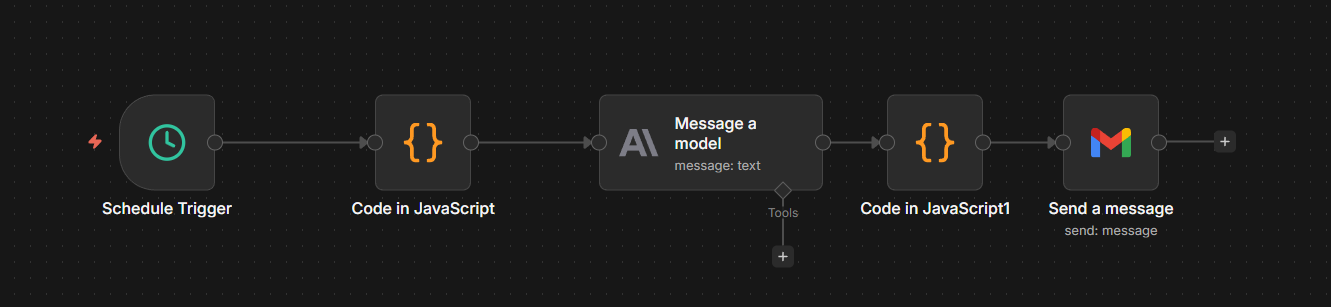
It pulls the latest articles from thirteen trusted sources in AI and healthcare technology. It filters for anything published in the last twenty-four hours and sends the full set to Claude through the API. Claude reads every article, picks the five to seven topics most relevant to what I write about, and writes a two to three sentence brief on why each one matters. The whole digest lands in my inbox, formatted and ready, before I have brewed a pot of coffee.
The spectrum is not just a way to think about agents. It is permission to build something smaller than the hype and still call it real.
Where the Wave Is Going
The agents most people will build are not the ones making headlines. They are the ones making mornings easier, weeks shorter, and recurring problems disappear. GitHub's Octoverse 2025 report found that nearly 80% of new developers there use GitHub Copilot, an AI coding assistant, within their first week. AI is no longer the advanced tool. It is the default one. The professionals who will benefit most from this shift are the ones who stop waiting for permission to participate.
Pick a recurring problem in your week. Pair with AI as your build partner. The version that solves your problem matters more than the one trending on social media. The right agent for you may not be impressive enough to demo. It will be useful enough to keep. Go build it.